Gadget Site

Enjoy Your Day With Gadget.

Gadget Site

Increase Your Knowledge About Gadget Here.

Gadget Site

All About Gadget.

Gadget Site

Explore For About Gadget.

Gadget Site

Stay Here.

Showing posts with label News Sport. Show all posts

Monmouth park or monmouth race track is the original track opened July 30

Source of Monmouth Park or Monmouth Park race track in the capture of Wikipedia. Monmouth park or monmouth race track is the original track opened July 30, 1870 in Long Branch, New Jersey. It was later bought by David D. Withers, George L. Lorillard, James Gordon Bennett, Jr., and George P. Wetmore after which Withers ran the facility for more than a decade during which time he helped found racings Board of Control, a predecessor to The Jockey Club. From 1882 to 1890, the track increased in popularity, but legislation proposed in 1891 and enacted in 1894 barred parimutuel betting in New Jersey, and the track closed its doors.
In 1946, the state legislature passed a bill providing for state regulation of horse racing. Spurred on by Amory L. Haskell, who led the legislative charge to once again permit wagering on horse racing in New Jersey and Philip H. Iselin, a New York City textile magnate, along with the backing of Reeve Schley, Joseph M. Roebling, John M. MacDonald, Townsend B. Martin, and James Cox Brady, Jr., the new Monmouth Park (organized as the Monmouth Park Jockey Club) reopened on June 19, 1946 after a 53-year hiatus with 18,724 in attendance.
The New Jersey Sports and Exposition Authority purchased Monmouth Park from its previous owners, the Monmouth Park Jockey Club, in 1985, in a deal valued at $45 million. The NJSEA still retains the corporate name "Monmouth Park Jockey Club".
Monmouth Park's marquee event is the Haskell Invitational Handicap, named after Amory L. Haskell. The Haskell was first run in 1968 as a handicap, but was made into an Invitational Handicap in 1981. It is now a 1 1/8-mile test for three-year-olds run in early August. Monmouth Park also now showcases the Jersey Derby originally run at Garden State Park until its closure in 2001.
In October 2007, Monmouth Park hosted the Breeders' Cup for the first time in its history.
The main track is a one mile dirt oval with chutes for 6 furlong and 1 1/4 mile races.The turf course is seven furlongs in circumference, with a diagonal chute for races between 1 mile and 1 1/8 miles. A re-design of the grass course for the 2006 season brought with it a new, second chute to accommodate 5 1/2 furlong sprint races. Turf races can be run along the hedge, or with the portable rail out 12 feet (dubbed the "Haskell Course"), 24 feet ("Monmouth Course") or 36 feet ("Lennox Course").
The Stable Area, located directly to the north of the back stretch of the main track, contains a total of thirty six barns and stables, eight north of the New Jersey Transit's North Jersey Coast Line (connected by its own service and access road) and twenty eight on the main complex.
The Wolf Hill Farm, which served Monmouth Park as a private stable and practice facility, is located adjacent to and immediately west of the main complex. Wolf Hill, owned and operated by the Valentino Family from the nearby City of Long Branch, New Jersey featured barns, stables and a practice track featuring a dirt oval and turf course identical to that at Monmouth Park's main facility only built to 50% scale. The Valentino Family sold Wolf Hill Farm to the Monmouth Park Jockey Club in 1963 which then became part of the greater Monmouth Park Complex. It was transferred to state ownership in the 1986 takeover by the NJSEA and was eventually sold to the Monmouth County Park System in 1998 which now operates the site as a passive recreation park. While Wolf Hill ceased operating as a farm following the 1963 sale, owners and trainers continued to use Wolf Hill's practice track well into the 1990s. Remnants of the practice track are still clearly visible on the site.

Michelle Kwan Profile


Michelle Wingshan Kwan. or can be called with Michelle Kwan (Traditional Chinese: ???; Simplified Chinese: ???; pinyin: Guan Yingshan; Cantonese IPA: Gwaan Wingsaan; born July 7, 1980) is an American figure skater. She has won nine U.S. championships, five World Championships, and two Olympic medals. She has remained competitive for over a decade and is the most decorated figure skater in U.S. history. Known for her consistency and expressive artistry on ice, she is widely considered one of the greatest figure skaters of all time.
Born in Torrance, California, Kwan is the third child of Danny and Estella Kwan, Chinese immigrants from Hong Kong. As a child, Michelle Kwan grew up speaking a mixture of Cantonese and English at home. In addition, she also speaks some conversational Mandarin. Kwan�s interest in figure skating began at the age of five when she followed her two older siblings (hockey player Ron and figure skater Karen) onto the ice. Karen and Michelle Kwan began serious training when Michelle Kwan was about eight years old. They practiced three to four hours a day, waking up at 3 am to skate before school and going back to the rink right after school to skate again. Paying for their increased skating-rink time led to financial hardship for Kwan�s working class family. When Kwan was ten years old, her family could no longer afford a coach, but they were offered financial assistance by a fellow member of the Los Angeles Figure Skating Club. That allowed them to train at the Ice Castle International Training Center in Lake Arrowhead, California.
Kwan attended Soleado Elementary School in Palos Verdes, California, but left public school to be homeschooled starting at the age of 13. After graduation from Rim of the World High School in 1998, she attended UCLA for one year. In the fall of 2006 she transferred to the University of Denver with the intent of majoring in political science and minoring in international studies. In June 2009, she graduated with a bachelor's degree in international studies and a minor in political science. She has since been accepted into the graduate international relations program at the Fletcher School of Law and Diplomacy at Tufts University and will be attending full-time instead of continue on to compete at the 2010 Olympics.

The original Ironman Triathlon

The idea for the original Ironman Triathlon arose during the awards ceremony for the 1977 Oahu Perimeter Relay (a running race for 5-person teams). Among the participants were numerous representatives of both the Mid-Pacific Road Runners and the Waikiki Swim Club, whose members had long been debating which athletes were more fit, runners or swimmers. Ironman Triathlon was the first major competition to extend the distance to an extreme endurance event. The first Ironman Triathlon was held on February 18, 1978 in Honolulu, Hawaii[1], repeated in 1979 and 1980.
On this occasion, U.S. Navy Commander John Collins pointed out that a recent article in Sports Illustrated magazine had declared that Eddy Merckx, the great Belgian cyclist, had the highest recorded "oxygen uptake" of any athlete ever measured, so perhaps cyclists were more fit than anyone. CDR Collins and his wife had taken part in the triathlons staged in 1974 and 1975 by the San Diego Track Club in and around Mission Bay, California, as well as the 1975 Optimist Sports Fiesta Triathlon in Coronado, California. A number of the other military athletes in attendance were also familiar with the San Diego races, so they understood the concept when CDR Collins suggested that the debate should be settled through a race combining the three existing long-distance competitions already on the island: the Waikiki Roughwater Swim (2.4 mi./3.86 km), the Around-Oahu Bike Race (115 mi./185.07 km; originally a two-day event) and the Honolulu Marathon (26.219 mi./42.195 km).
Until that point, no one present had ever done the bike race; CDR Collins calculated that, by shaving 3 miles (4.8 km) off the course and riding counter-clockwise around the island, the bike leg could start at the finish of the Waikiki Rough Water and end at the Aloha Tower, the traditional start of the Honolulu Marathon. Prior to racing, each athlete received three sheets of paper listing a few rules and a course description. Handwritten on the last page was this exhortation: "Swim 2.4 miles! Bike 112 miles! Run 26.2 miles! Brag for the rest of your life", now a registered trademark.
With a nod to a local runner who was notorious for his demanding workouts, Collins said, "Whoever finishes first, we'll call him the Iron Man." Each of the racers had their own support crew to supply water, food and encouragement during the event. Of the fifteen men to start off in the early morning on February 18, 1978, twelve completed the race. Gordon Haller was the first to earn the title Ironman by completing the course, with a time of 11 hours, 46 minutes, and 58 seconds.
With no further marketing efforts, the race gathered as many as 50 athletes in 1979. The race, however, was postponed a day because of bad weather conditions and only fifteen competitors started off the race Sunday morning. San Diego's Tom Warren won in 11 hours, 15 minutes, and 56 seconds. Lyn Lemaire, a championship cyclist from Boston, placed sixth overall and became the first "Ironwoman".
Collins planned on changing the race into a relay event to draw more participants, but Sports Illustrated's journalist Barry McDermott, in the area to cover a golf tournament, discovered the race and wrote a ten page account of it. During the following year, hundreds of curious participants contacted Collins.
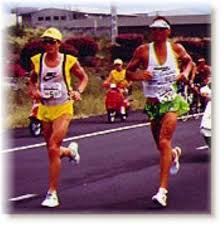
An Ironman Triathlon is one of a series of long-distance triathlon races organized by the World Triathlon Corporation (WTC) consisting of a 2.4 miles (3.86 km) swim, a 112 miles (180.25 km) bike and a marathon (26 miles 385 yards, 42.195 km) run, raced in that order and without a break.
The Ironman Triathlon, or The Ironman Triathlon World Championships, or Ironman Hawaii, is both the original Ironman triathlon and the annual world championships of the event, held annually in Hawai'i since 1978, with an additional race in 1982. It was made famous by its grueling length, harsh race conditions, and television coverage.


In 1981 the competition was moved to the less urbanized Big Island by Valerie Silk and in 1982 Silk moved the race date from February to October; as a result of this change there were two Ironman Triathlon events in 1982.
A milestone in the marketing of the legend and history of the race happened in February 1982. Julie Moss, a college student competing to gather research for her exercise physiology thesis, moved toward the finish line in first place. As she came nearer to the finish line, severe fatigue and dehydration set in, falling yards away from the finish line. Although Kathleen McCartney passed her for the women�s title, Moss nevertheless crawled to the finish line. Her performance was broadcast worldwide and created the Ironman mantra that just finishing is a victory.
The sport of triathlon was added as an Olympic sport at the 2000 Summer Olympics in Sydney as a shorter distance race (1,500-metre (0.93 mi) swim, 40-kilometre (25 mi) cycle, 10-kilometre (6.2 mi) run).
There have been a number of non-WTC "Ironman Distance" triathlons that have been held since the mid-1990s. The limited number of WTC-sanctioned events, and the limited number of entries available per race have combined with a growth in the sport that has created demand for these non-trademarked events. Many of them share the 2.4-mile (3.9 km), 112-mile (180 km), 26.2-mile (42.2 km) format with Ironman. Originally, many used the Ironman name. Due to aggressive trademark protection, most of these races no longer use the word "Ironman". The largest of these include the Vineman Triathlon, Silverman Triathlon and Californiaman Triathlon.
The original Ironman is held in conditions which are uniquely punishing for endurance racing: the Hawaii water is warm enough that helpfully buoyant wetsuits are not allowed; though the cycling hills have only moderate gradients they are normally crossed by strong and gusting winds; and the marathon leg of the race is usually extremely hot. Other races under the WTC aegis have their own difficulties, characteristic of their setting and season. Anyone completing one of these races within the time limit, so long as it is the prescribed distance, is entitled to call themself an Ironman (the term being gender-neutral). At one time there was no cut-off time, then a 15 hour time limit - for these events the normal time limit is now 17 hours. Some iron distance races (not sanctioned by the WTC corporation, but using the same standard distances) have different cut-off times.(takken from wikipedia.org}

Tour de france stage 18 results 2009

Tour De France Stage 18 Results 2009. After Andy Schleck and Frank Schleck dominated the Queen of Stage 17 by gaining more than two minutes on Armstrong, Wiggins, and Kloden, the Tour De France Stage 18 Results will be another story for it will be a 40-kilometer Individual time trial.
The Tour De France Stage 18 Individual Time Trial will be in the advantage of Wiggins, Contador, and Armstrong that the Schleck brothers will try to stay in with them
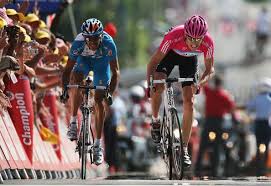
At the Tour de France 2009, the art of the breakaway is being mastered by men of strength and courage.
In recent Tour history, rarely have there been so many successful escape attempts. With our without the controversial team radios, such men, when they attack, do not care how outnumbered they are or how remote the possibility of victory may be. They simply attack because it's in their nature, it's in their blood. It's the only thing they know how to do.
On the first of two giant mountains both named Bernard, Mikel Astarloza felt his name being called.

Tour De France Stage 18 Results 2009

1. CONTADOR Alberto 21 ASTANA 48' 30?
2. CANCELLARA Fabian 33 TEAM SAXO BANK 48' 33? + 00' 03?
3. IGNATIEV Mikhail 164 TEAM KATUSHA 48' 45? + 00' 15?
4. LARSSON Gustav 34 TEAM SAXO BANK 49' 03? + 00' 33?
5. MILLAR David 56 GARMIN - SLIPSTREAM 49' 11? + 00' 41?
6. WIGGINS Bradley 58 GARMIN - SLIPSTREAM 49' 13? + 00' 43?
7. SANCHEZ Luis-Leon 118 CAISSE D�EPARGNE 49' 14? + 00' 44?
8. MOREAU Christophe 171 AGRITUBEL 49' 15? + 00' 45?
9. KL�DEN Andr�as 23 ASTANA 49' 24? + 00' 54?
10. ZABRISKIE David 59 GARMIN - SLIPSTREAM 49' 32? + 01' 02?
11. MARTIN Tony 76 TEAM COLUMBIA - HTC 49' 34? + 01' 04?
12. EVANS Cadel 11 SILENCE - LOTTO 49' 44? + 01' 14?
13. MONFORT Maxime 77 TEAM COLUMBIA - HTC 49' 49? + 01' 19?
14. CHAVANEL Sylvain 151 QUICK STEP 49' 50? + 01' 20?
15. KARPETS Vladimir 161 TEAM KATUSHA 49' 58? + 01' 28?
16. ARMSTRONG Lance 22 ASTANA 50' 00? + 01' 30?
17. CLEMENT Stef 42 RABOBANK 50' 07? + 01' 37?
18. GRABSCH Bert 73 TEAM COLUMBIA - HTC 50' 08? + 01' 38?
19. ROGERS Michael 79 TEAM COLUMBIA - HTC 50' 08? + 01' 38?
20. KIRCHEN Kim 75 TEAM COLUMBIA - HTC 50' 12? + 01' 42?

Share

Twitter Delicious Facebook Digg Stumbleupon Favorites